
A cookie policy is a legal document that explains how your website uses cookies, what data they collect, and how users can control their preferences.
Privacy laws like the GDPR, ePrivacy Directive, and CCPA require websites to disclose their use of cookies and, in some cases, obtain user consent before placing them. Even where it is not strictly required, having a cookie policy is considered a best practice for transparency and trust.
In this blog, we’ll walk you through what a cookie policy should include and provide a simple, ready-to-use cookie policy template that you can adapt for your website.
What is a cookie policy?
A cookie policy is a dedicated document that clearly explains how your website uses cookies and similar tracking technologies. It should help users understand what cookies are, the types of cookies your website uses, what kind of data they collect, and why they are used. Just as important, it should explain how visitors can control their preferences or withdraw consent at any time.
In many ways, a cookie policy works like a focused extension of your privacy policy, specifically addressing how tracking technologies operate on your website. It also plays a key role in helping businesses meet privacy requirements under laws such as the GDPR, ePrivacy rules, and data protection frameworks in other regions.

Also read
Do you need a cookie policy?
A cookie policy is part of compliance, and it helps present your cookie and other tracking practices in a clear and transparent way. While laws may not always necessitate a separate cookie policy as a standalone document, they do require clear, specific disclosure of how cookies are used.
Simply including cookie information within a broader privacy policy can fall short of these requirements. Privacy policies are often long and general, which makes cookie-related disclosures harder to find and understand. This can undermine the principle of transparency expected under laws like the GDPR and ePrivacy Directive.
Creating a dedicated cookies policy solves this problem. It allows you to present detailed, easy-to-access information about your cookie usage and supports your consent mechanism more effectively.
In practice, a standalone cookie policy is the most reliable way to stay compliant while giving users the clarity they expect.
Free cookie policy template: GDPR & CCPA compliant
Download this free cookie policy template as a Word DOCX file.
Key components of a cookie policy
A cookie policy should reflect how your website actually uses cookies. It should be clear, structured, and easy for users to understand. Below are the essential components every cookie policy should include.
Introduction
Start by introducing your organisation/website and a simple explanation of cookies.
Internet cookies are small text files stored on a user’s device when they visit a website. Some cookies are necessary for the website to function, while others help with analytics, preferences, or advertising.
Types of cookies used
Clearly list the categories of cookies used on your website. Common types include:
- Essential cookies that enable basic website functionality
- Analytics cookies that track how users interact with your site
- Functional cookies that remember user preferences
- Advertising cookies that help deliver relevant ads
- Grouping cookies this way makes it easier for users to understand their purpose.
Cookie information
Name individual cookies, who places them (domain), and explain what they do. For example, cookies may be used to:
- Keep users logged in
- Measure website performance
- Improve user experience
- Deliver targeted advertising
This section should connect cookie types to real use cases.
Information collected by cookies
Be clear about the type of data collected. This may include:
- Device information
- Browsing behavior
- Session data
- Preferences
Make it clear that the data collected is relevant to functionality and user experience.
Cookie duration
Explain how long cookies remain on a user’s device.
- Session cookies expire when the browser is closed
- Persistent cookies remain for a defined period
This distinction helps users understand how long their data is stored.
Third-party cookies
If your website uses third-party services, this must be disclosed.
Third-party cookies are set by external providers such as analytics tools or advertising platforms. These cookies may track users across different websites.
How users can manage cookies
This is very important for compliance. Explain how users can:
- Accept or reject cookies using your consent banner
- Change preferences later
- Disable cookies through browser settings
Impact of disabling cookies
Be transparent about what happens if cookies are turned off. For example:
- Some features may not work properly
- Login sessions may not persist
- Personalization may be limited
This helps users make informed choices.
Updates to the cookie policy
Mention that your cookie policy may change over time. Explain:
- How updates will be communicated
- That the “last updated” date will be revised
- Encourage users to review the policy periodically.
Contact information
End with a clear way for users to reach you. Include:
- Email address
- Contact form
- Business contact details if relevant
This shows accountability and improves trust.
Best practices for writing a cookie policy
Follow these cookie policy best practices for your website:
- Keep it simple: Avoid legal jargon. Write in plain language that users can understand.
- Make it specific: Do not rely on a generic template. Reflect your actual cookie usage.
- Align with your consent banner: Your cookie policy and consent banner should match.
- Keep it accessible: Link it in your website footer and from your cookie banner. Make it easy to find.
- Update regularly: Review your policy whenever your tools or tracking methods change.
Cookie policy vs privacy policy: Are they the same?
No. They are separate documents, though both relate to data privacy.
- A cookie policy explains how your website uses cookies and other tracking technologies.
- A privacy policy covers how you collect, use, store, and share personal data in general.
Both serve different purposes, and having both helps ensure your website meets privacy requirements clearly and effectively.
Different methods to create a cookie policy
You have three main options depending on your time, resources, and level of accuracy required.
- Write it manually: This gives you full control over the content and structure of your cookie policy. It works well if you understand your website’s cookie usage in detail and have legal knowledge. But it can be time-consuming and easy to miss important disclosures.
- Use a template: A template helps you get started quickly with a structured format. It still requires careful editing to reflect your actual cookie practices and ensure the policy is accurate.
- Use a cookie policy generator: This is the most efficient and reliable option for most websites. A cookie policy generator scans your website, identifies the cookies in use, and creates a policy that aligns with your setup.

Explore cookie policy generator features
How to create a cookie policy for my website?
Here are step-by-step instructions on creating an effective cookie policy for your website:
Step 1: Scan your website for cookies
Start by identifying all the cookies your website uses, including first-party and third-party cookies. This helps you understand what needs to be disclosed in your policy.
Step 2: Categorise and document cookie details
Group cookies into categories such as necessary, analytics, and advertising, and note their purpose and duration. This ensures your cookie policy is clear and easy for users to understand.
Step 3: Compile the document
Prepare your cookie policy by clearly explaining how your website uses cookies, including their purpose, categories, and duration.
Step 4: Publish
Publish the policy on your website and make sure it is easy to access. Link it from your cookie banner, privacy policy, and other relevant sections. That's it, your cookie policy is good to go!
GDPR and CCPA cookie policy requirements
If your website has users in regions like the EU or California, your cookie practices must meet specific legal requirements. While the laws differ, both focus on transparency and user control.
GDPR and ePrivacy requirements
Under the GDPR and ePrivacy rules, websites must clearly inform users about the use of cookies and obtain consent before placing non-essential cookies.
This means you should:
- Explain what cookies are and why they are used
- Categorise cookies (for example, necessary, analytics, advertising)
- Obtain prior consent before setting non-essential cookies
- Allow users to accept, reject, or customise cookie preferences
- Provide an easy way to withdraw consent at any time
- Consent must be freely given, specific, and informed.
CCPA and US requirements
Under the CCPA, the focus is on disclosure and the right to opt out of data sharing.
You should:
- Disclose how cookies and tracking technologies collect personal information
- Explain whether data is shared or sold to third parties
- Provide a clear “Do Not Sell or Share My Personal Information” option
- Honour user opt-out signals where applicable.
- Recognise global opt-outs.
Unlike GDPR, prior consent is not always required, but users must be given clear control over their data.
Where to display your cookie policy?
Your cookie policy should be easy to find and access at any time. Placing it in the right locations helps users understand your data practices and supports transparency.
Here are the key places where you should display your cookie policy:
- Website footer: Add a link to your cookie policy in the footer so it is accessible from every page on your website.
- Cookie consent banner: Include a link within your cookie banner so users can review the policy before giving consent.
- Privacy policy page: Link your cookie policy from your privacy policy to provide a complete view of how user data is handled.
Making your cookie policy easy to access ensures users can review it whenever they want and helps you meet transparency requirements.
Cookie policy examples
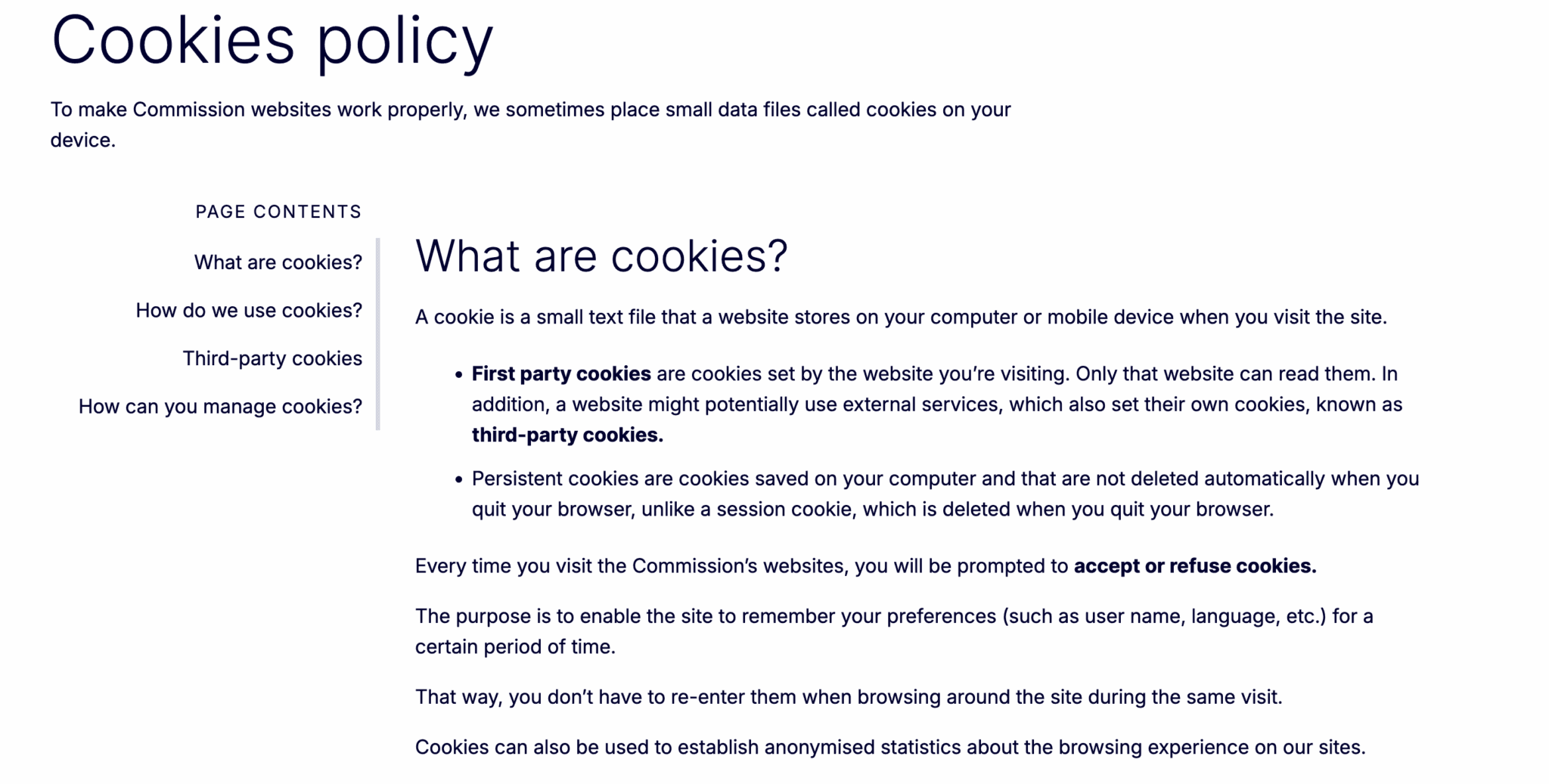
European Commission
As an EU regulatory body, the European Commission's own cookie policy sets a high bar for transparency. It uses jump links for navigation, presents each cookie in a clearly formatted table (name, purpose, duration), and is written in language accessible to non-technical readers.
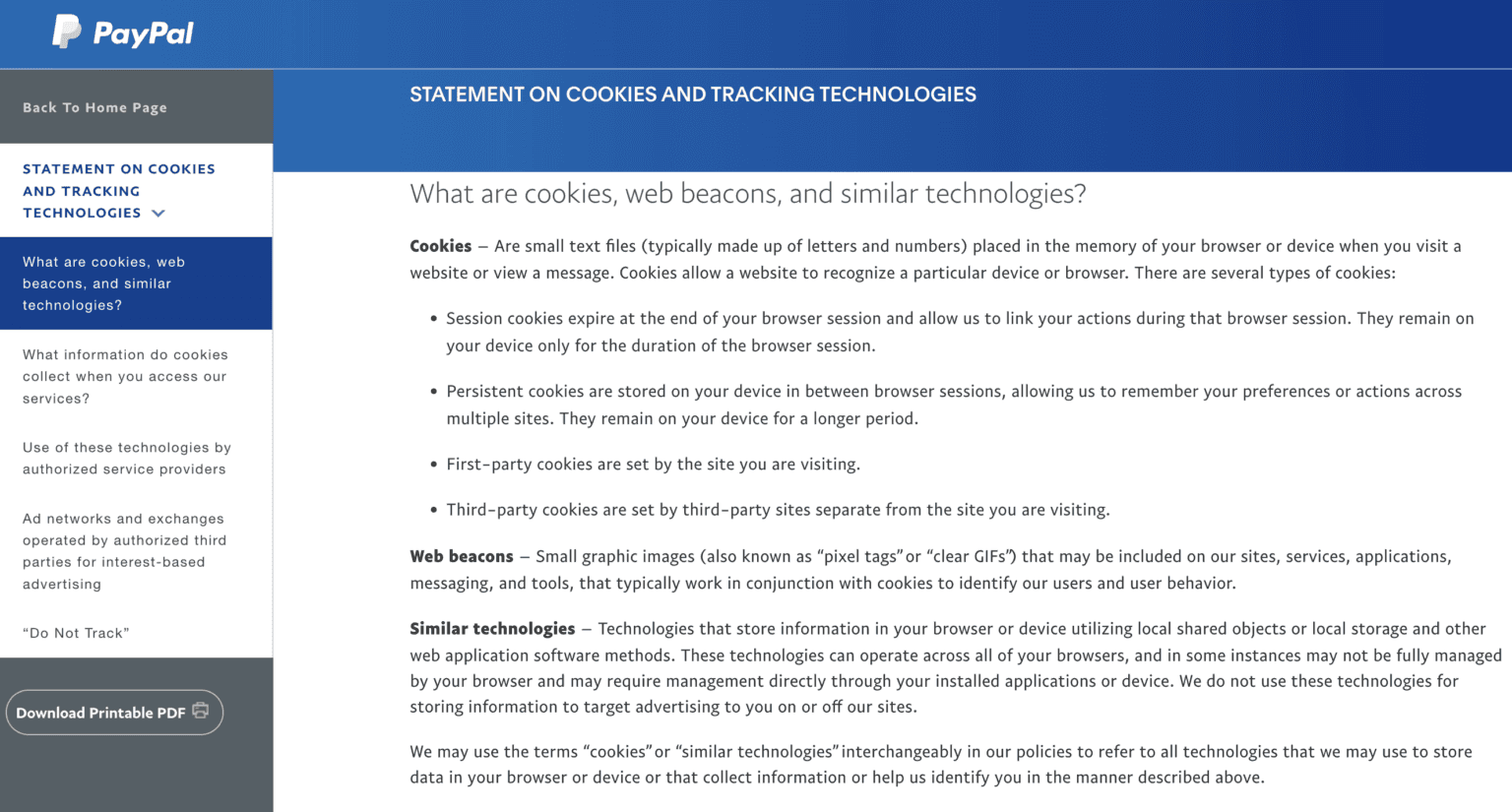
PayPal
PayPal's standalone cookie policy is clearly dated, section-navigable, and available as a downloadable PDF. It places particular emphasis on cookies used for security and fraud prevention, reflecting the sensitivity of the data its platform handles.
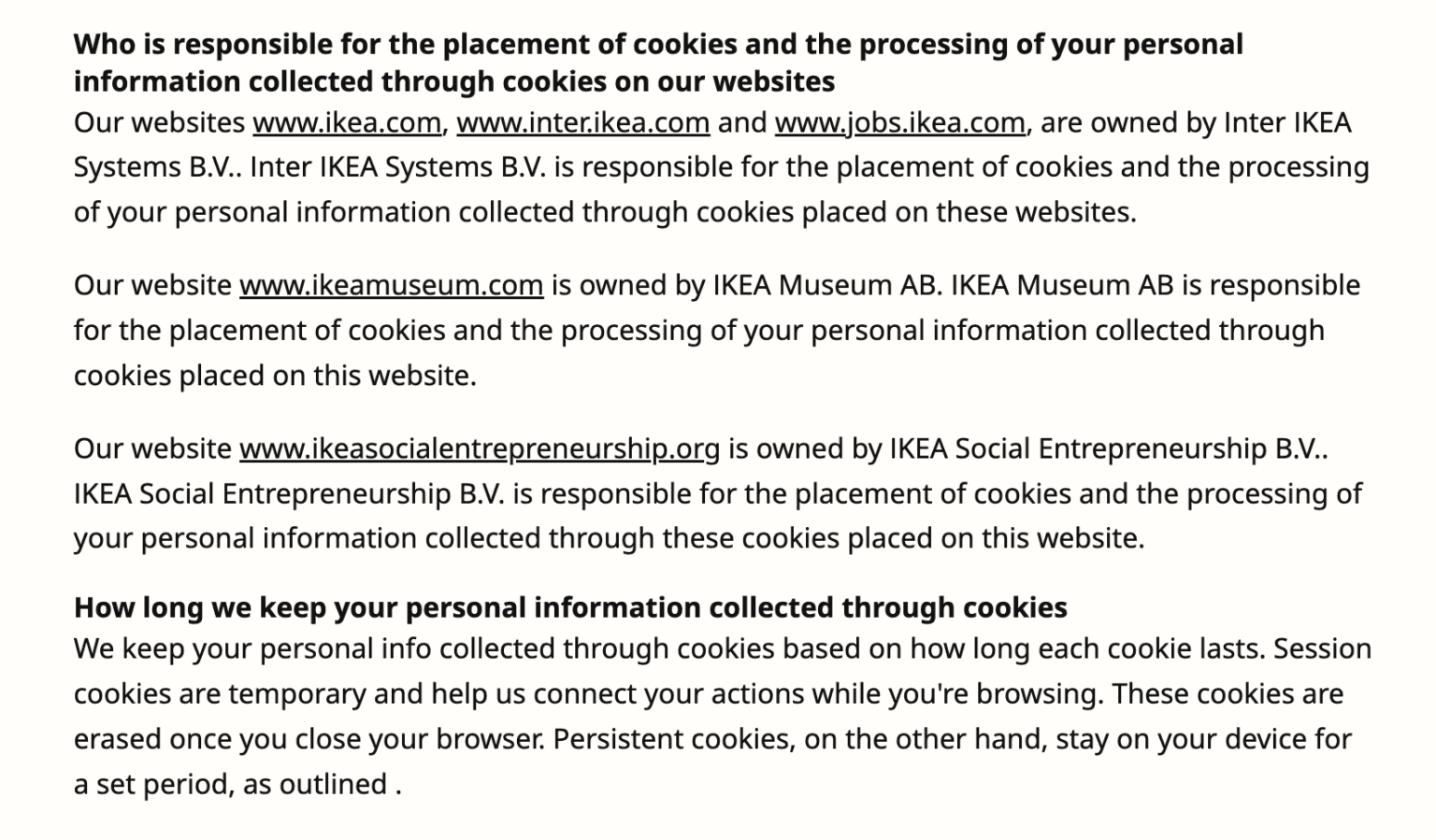
IKEA
IKEA's Privacy and Cookie Statement is notable for explicitly identifying which IKEA legal entities are responsible for placing cookies across different websites. It defines cookie categories (functional, preference, analytical, and marketing), states the legal basis for each, and specifies data retention durations.
Why use Cookie Policy Generator by CookieYes?
A manually written cookie policy is outdated the moment you add a new integration. Cookie policy generator by CookieYes scans your site, identifies every cookie in use, and generates a fully compliant policy in minutes accurate, categorised, and ready to publish. And as your stack evolves, it automatically updates your policy to match, keeping your disclosures accurate and updated.

Safna
CIPP/E from the International Association of Privacy Professionals (IAPP) | Data privacy writer
Keep reading
GDPR Compliant Cookie Policy: Complete Requirements Checklist
Create a GDPR-compliant cookie policy with essential clauses and transparency guidelines to ensure full EU privacy compliance.
Cookie Policy for WordPress: A Complete Guide
WordPress cookie policy guide: what to include, GDPR/CCPA requirements, cookie categories, and how to generate and keep your policy updated.